SOA OS23: Understanding the Dual Meaning Behind
In today’s rapidly transforming digital and industrial environment, one term is quietly reshaping both IT and construction conversations — SOA OS23. You’ll find it mentioned in whitepapers, procurement documents, and strategic frameworks, yet few professionals can confidently define it. What exactly is SOA OS23? Why does it matter across such different industries — from cloud software to demolition contracting?
This article dives deep into both interpretations of SOA OS23, explaining what it stands for, how it’s applied in software architecture and public works certification, and what benefits and challenges come with it. By the end, you’ll understand how to use SOA OS23 to your organization’s advantage, whether you’re building scalable digital systems or qualifying for high-value infrastructure tenders.
What Is SOA OS23?
The phrase SOA OS23 has two dominant interpretations depending on the professional context. While the acronym SOA often means Service-Oriented Architecture in technology, it also refers to Società Organismo di Attestazione in the construction industry, particularly in Italy. Let’s break it down.
SOA OS23 in Software Architecture
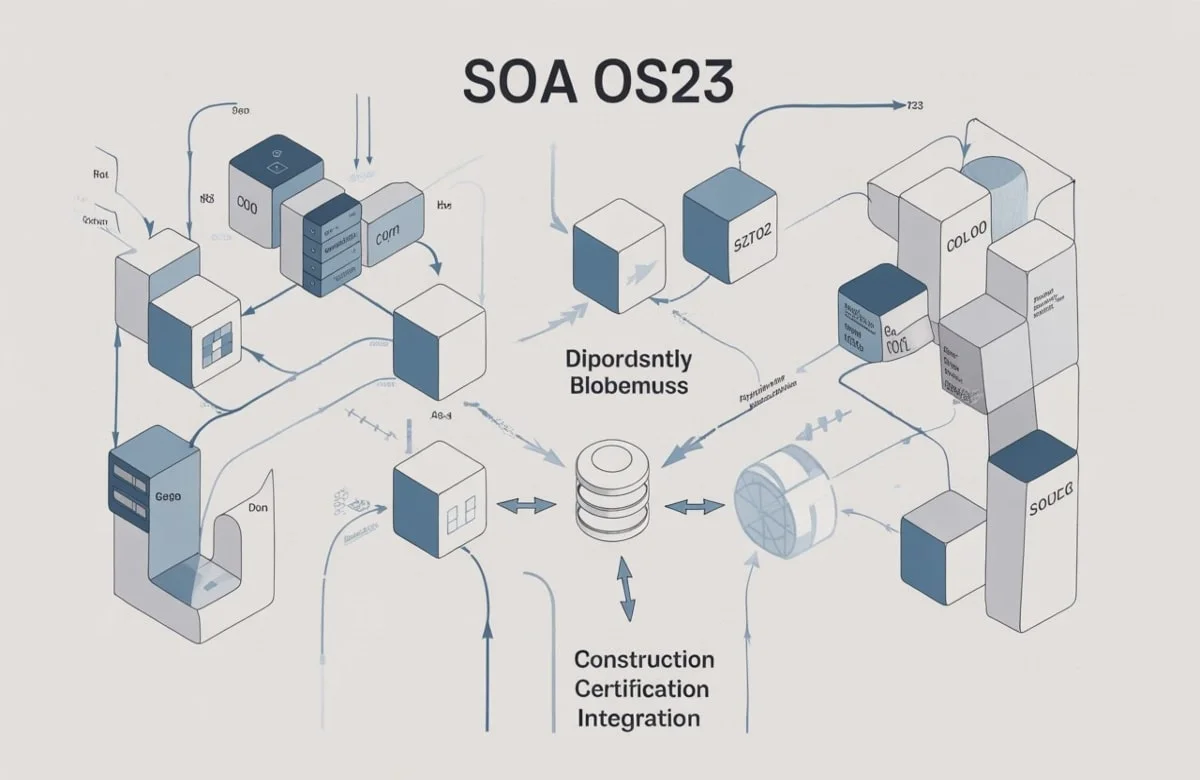
In the world of IT and cloud computing, It is commonly interpreted as Service-Oriented Architecture – Operating Standard 2023 (or Open Standard 23). It represents an evolved version of traditional SOA, designed for the era of microservices, event-driven systems, edge computing, and cloud-native deployments.
Where traditional SOA focused on interoperability and service reuse, SOA OS23 pushes further — embedding governance, compliance, and real-time event processing at its core.
Key focus areas include:
-
Modular microservices with independent deployment
-
Event-driven, asynchronous communication patterns
-
Polyglot and hybrid environments (cloud, on-premise, edge)
-
Built-in governance, observability, and zero-trust security
This modern interpretation ensures that enterprise systems remain scalable, resilient, and regulatory-ready, even across distributed infrastructures.
SOA OS23 in Public Procurement and Construction
In construction and public procurement, SOA OS23 refers to a specific certification category under Italy’s SOA regime — a qualification system ensuring that contractors meet technical, financial, and organizational standards before bidding for public works.
Here, “OS23” stands for the specialized works category covering demolition activities. Companies holding this certification are legally recognized as qualified to carry out public demolition contracts.
The OS23 certification guarantees that a firm:
-
Possesses adequate equipment, experience, and workforce
-
Follows safety, environmental, and waste management standards
-
Has the financial capacity to handle large-scale demolition projects
So, depending on whether you’re an IT architect or a civil contractor, SOA OS23 either describes a next-generation service architecture or a specialized demolition certification.
Why the Dual Meaning Matters
It’s not often that one acronym connects both software design and construction compliance. But the overlap between the two worlds highlights a common thread: modularity, standardization, and governance.
In IT, SOA OS23 helps break down monolithic systems into manageable microservices. In construction, OS23 certification divides public works into specialized categories, ensuring each area is handled by qualified professionals.
Both meanings reinforce a modern principle — specialization and accountability are key to scalability, safety, and success.
Why SOA OS23 Is Important Today
From a Software Perspective
Digital transformation has made old IT frameworks obsolete. Businesses now require systems that are flexible, secure, and real-time. SOA OS23 helps achieve this by introducing architectural discipline that supports:
-
Scalability: Each service can grow independently without overloading the system.
-
Interoperability: Polyglot environments support multiple languages (Java, Python, Go, etc.).
-
Security: Embedded compliance and zero-trust mechanisms reduce cyber risks.
-
Agility: Event-driven communication enables real-time responsiveness for IoT, logistics, and finance applications.
In short, It is ensures enterprises stay agile in a hybrid, multi-cloud world.
From a Construction Perspective
In the public works ecosystem,It is certification gives contractors a competitive edge. With increasing emphasis on safety, sustainability, and accountability, government bodies only work with certified firms.
For demolition contractors, this certification acts as both a license to operate and a badge of credibility. It demonstrates expertise in managing structural dismantling, debris recycling, and environmental risks — all while complying with national safety regulations.
Thus, It is context isn’t just a document — it’s a gateway to larger tenders and stronger trust.
Core Principles of SOA OS23 (Software View)
The software version of builds on several key architectural principles designed for the modern era:
-
Service-First Modularity: Systems are built from small, independent services that can be scaled, maintained, or replaced individually.
-
Event-Driven Asynchrony: Instead of rigid request-response models, services communicate through real-time events, ensuring efficiency and resilience.
-
Polyglot Freedom: Developers can use different languages and frameworks depending on business needs.
-
Security by Design: Authentication, encryption, and compliance tracking are native features, not afterthoughts.
-
Self-Healing and Observability: It is promotes intelligent monitoring, automated fault recovery, and adaptive scaling.
These pillars ensure that modern digital systems stay robust, compliant, and adaptable even under unpredictable workloads.
Scope and Requirements of OS23 Certification
In Italy’s public procurement system, It is covers demolition works (Opere Specializzate). This certification ensures that only qualified contractors handle sensitive and technically demanding tasks.
To qualify, a company must:
-
Show evidence of past demolition projects meeting certain value thresholds.
-
Prove ownership or access to professional demolition equipment.
-
Maintain a safe and environmentally responsible operation.
-
Demonstrate sufficient financial turnover for the desired certification class (“classe”).
Each certification class defines the maximum contract value a firm can bid for, ranging from smaller projects to multi-million-euro demolitions. Renewal requires ongoing compliance and proof of updated safety and technical standards.
Real-World Example: Applying SOA OS23 in Practice
Consider a European smart city initiative that simultaneously integrates advanced IT systems and urban redevelopment.
On the digital side, city planners adopt the SOA OS23 architectural model to manage IoT-based traffic control, waste management, and emergency response systems. Each function operates as a modular service — independent, event-driven, and secure — allowing real-time city management.
Meanwhile, on the construction side, certified OS23 contractors handle demolition and restructuring of old infrastructures safely and sustainably, recycling materials and maintaining environmental compliance.
Together, these dual implementations of SOA OS23 — one digital, one physical — showcase how modern governance and modular design can build smarter, safer cities.
Benefits of Adopting SOA OS23
For Software Organizations
-
Faster innovation: Independent service modules shorten deployment cycles.
-
Enhanced reliability: Failures in one service don’t affect others.
-
Built-in compliance: Meets modern data protection and audit standards.
-
Future-proof scalability: Ready for multi-cloud and edge computing.
For Construction Firms
-
Tender eligibility: Legal access to public demolition contracts.
-
Higher credibility: Certified expertise improves trust with clients.
-
Operational safety: Compliance ensures lower accident and liability risks.
-
Competitive differentiation: Distinguishes qualified firms from uncertified competitors.
Challenges of SOA OS23 Implementation
Despite its clear benefits, adopting or qualifying for involves real-world challenges.
For software architects, complexity is often the main hurdle. Designing event-driven, polyglot systems requires advanced skills, tooling, and governance. Legacy migration can also be time-consuming and costly.
For construction firms, documentation and compliance are the biggest pain points. Maintaining updated records, meeting safety standards, and proving technical capacity require ongoing investment.
However, both industries agree: the long-term ROI of SOA OS23 — in resilience, safety, and scalability — far outweighs the short-term challenges.
How to Implement SOA OS23 Successfully
The road to success with depends on clarity and planning.
For software teams, start small. Identify one process that would benefit from modularization, such as customer notifications or reporting. Implement it using event-driven design and proper observability tools. Gradually expand across your architecture, ensuring each service aligns with OS23 principles of autonomy, scalability, and governance.
For construction companies, begin by auditing your project history, equipment inventory, and safety documentation. Partner with a certified SOA body to guide you through the OS23 application process. Maintain transparent records and stay updated on national procurement regulations.
In both cases, governance is key — it’s what transforms a checklist into a living, adaptive system.
Comparison: Traditional Approaches vs SOA OS23
| Aspect | Traditional SOA / Certification | SOA OS23 Approach |
|---|---|---|
| Interaction Model | Synchronous, tightly coupled | Asynchronous, event-driven |
| Deployment | Monolithic, on-premise | Modular, hybrid/edge-ready |
| Governance | Added later | Built-in from the start |
| Scalability | Limited | Dynamic and automated |
| Qualification (Construction) | General eligibility | Specialized demolition certification |
Future of SOA OS23
As both digital and physical infrastructure evolve, It will continue to gain importance.
In IT, trends like AI integration, IoT expansion, and edge computing demand architectures that are flexible and event-driven — exactly what OS23 delivers. For construction, increasing specialization, safety standards, and digital compliance systems make OS23 certification indispensable for serious contractors.
According to European Commission Procurement Guidelines, certified specialization ensures higher accountability in public works. Similarly, frameworks like The Open Group’s SOA Standards highlight modularity and interoperability — the very principles behind software.
Both paths are converging toward a future where governance, modularity, and compliance define professional excellence.
Conclusion: Turning SOA OS23 into Strategic Advantage
Whether you operate in IT or construction, It is more than a trend — it’s a mindset.
In software, it empowers organizations to build secure, modular, and scalable architectures ready for hybrid and edge deployments. In construction, it opens access to specialized, high-value projects backed by compliance and trust.
The lesson is universal: success in the 2020s depends on structured flexibility — the ability to adapt while maintaining governance. Embrace SOA OS23, align it with your goals, and make it a cornerstone of your digital or operational strategy.
Ready to future-proof your organization? Start implementing or qualifying under SOA OS23 today — because those who lead with structure and innovation will define tomorrow’s standards.
FAQs
1. What does SOA OS23 mean?
It refers either to Service-Oriented Architecture – Operating Standard 2023 in software or the OS23 demolition certification in Italian public procurement.
2. How is SOA OS23 different from traditional SOA?
It expands on old SOA principles by adding event-driven design, hybrid deployments, and built-in compliance.
3. Why do construction firms need OS23 certification?
It legally qualifies them to bid on public demolition tenders and demonstrates compliance with safety and environmental standards.
4. Can SOA OS23 improve IT security?
Yes. Its zero-trust, encrypted communication and governance-first design significantly enhance enterprise cybersecurity.
5. What’s the future of SOA OS23?
As cloud systems and infrastructure projects grow more complex, It will become a key requirement for both technical and operational excellence.